
How to Find Genesee County Arrest Records
The arrest itself is logged by the arresting agency. The case then moves to the 67th District Court for arraignment. For felonies, the case shifts to the 7th Circuit Court after bindover. Because of this split, an arrest record search starts with the Sheriff's Office or police agency, then continues through the court system. The Genesee County Sheriff's Office handles the county jail at 1002 South Saginaw Street and oversees countywide arrests. The Sheriff's site does not publish a public online roster, so current custody status is verified by direct contact with the jail or through VINELink.
Court-side arrest data shows up in MiCOURT after arraignment. The 67th District Court page (code D67) lists the bond, the charge, and the next hearing. The 7th Circuit Court page (code C07) takes over once the felony case is bound over. The Michigan Department of Corrections OTIS database covers people sentenced to state prison, parole, or probation, but not pretrial detainees in the county jail.
- Call the Genesee County Jail or the arresting police agency for current custody status if the arrest happened in the last 24-48 hours.
- Search MiCOURT D67 for the 67th District Court arraignment and bond information.
- Search MiCOURT C07 for the 7th Circuit Court file after a felony is bound over.
- Check the Michigan DOC OTIS for people serving a state prison or parole sentence.
- Check the Michigan Public Sex Offender Registry for registered sex offenders living in Genesee County.
- Use the VINELink portal for custody status notifications by phone or email.
The image below links to the Michigan DOC OTIS database, the official source for Michigan state prison and supervision data.
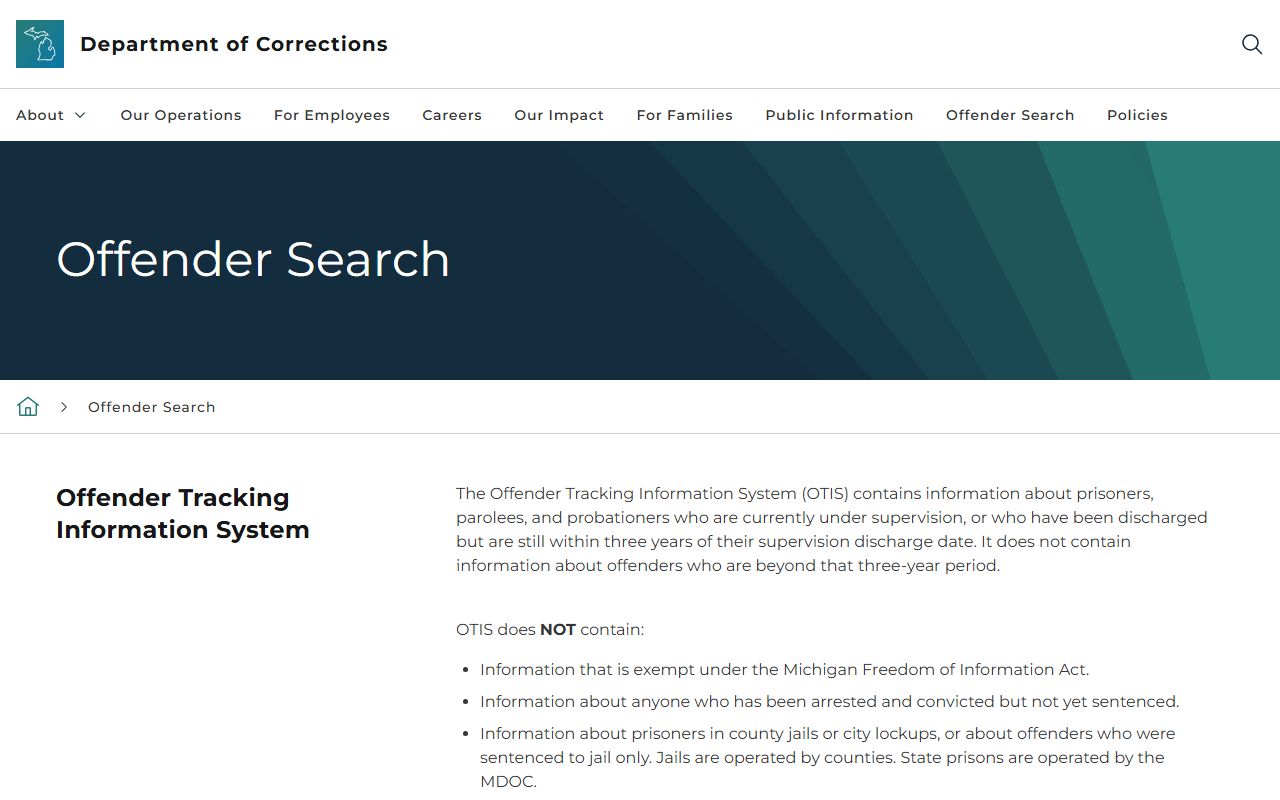
OTIS does not cover county jail custody, so it should be paired with a Genesee County Sheriff or 67th District Court search for active arrests.
Arrest Record vs. Criminal Court Record
An arrest record and a criminal court record are not the same. An arrest record is created by law enforcement at the time of booking. A criminal court record is created by the court once charges are filed and arraigned. Many arrests never become court cases; many court cases involve charges that change between arrest and arraignment. The distinction matters for background checks, employment screening, and licensing applications.
| Arrest Record | Criminal Court Record | |
|---|---|---|
| Source | Sheriff or local police agency | 67th District Court or 7th Circuit Court |
| Content | Booking photo, charge at arrest, jail entry, bond | Filed charges, plea, sentence, disposition |
| Created at | Arrest and booking | Arraignment and beyond |
| Where to search | Jail, Sheriff, VINELink | MiCOURT D67 / C07 |
| Public access | Often limited; no countywide roster online | Public unless sealed, set aside, or juvenile |
For full criminal history detail, the Genesee County court records page covers the case-side search, while the arrest side is the focus here.
Charges vs. Convictions in Genesee County
A charge is what the prosecutor files. A conviction is what the case becomes after a plea or trial. A Genesee County arrest record may show a felony charge that gets reduced to a misdemeanor at sentencing, or a charge that gets dismissed entirely. Background checks that rely only on arrest data overstate criminal history because they do not distinguish between what was charged and what stuck.
For accurate criminal history, the disposition line on the court record is the line that counts. The Register of Actions shows whether a charge ended in conviction, dismissal, or set aside. Set-aside cases under MCL 780.621 are removed from public criminal history. Pending cases show charges with no disposition. The court file, not the arrest blotter, is the right source for legal conclusions.
Sealed vs. Set-Aside Records in Michigan
Michigan uses "set aside" instead of the more common "expungement." A set aside under MCL 780.621 removes an eligible conviction from public criminal history. Sealing is a separate process under MCR 8.119(I) that requires a judge to seal a court file on specific findings. The two are different and produce different public-access results.
| Set Aside (MCL 780.621) | Sealed (MCR 8.119(I)) | |
|---|---|---|
| Statute or rule | MCL 780.621 et seq. | Michigan Court Rule 8.119(I) |
| Process | Application in the convicting court | Motion with judge's findings |
| Public criminal history | Removed for eligible convictions | Case file removed or restricted |
| Driving record | May remain under MCL 780.621c | Depends on judge's order |
| Government access | Some agencies retain access | Depends on order; court keeps file |
The 67th District Court links the SCAO MC 227 series forms for Clean Slate set-aside applications. The court requires one application per case and accepts email, in-person, and mail submissions to the Records Processing office.
State Criminal History (MSP ICHAT)
The Michigan State Police runs the Internet Criminal History Access Tool, called ICHAT. ICHAT is a paid statewide name-based criminal history search through MSP. ICHAT returns Michigan public criminal history records held by MSP, separate from the court-by-court MiCOURT search. ICHAT does not include federal records, sealed records, or juvenile records. For Genesee County, ICHAT is useful when a background check needs Michigan-wide history rather than just Genesee court files.
The Michigan State Police also runs the Sex Offender Registry. The registry includes Genesee County registrants searchable by name, address, ZIP code, county, or radius. The image below links to the Michigan Public Sex Offender Registry search portal.
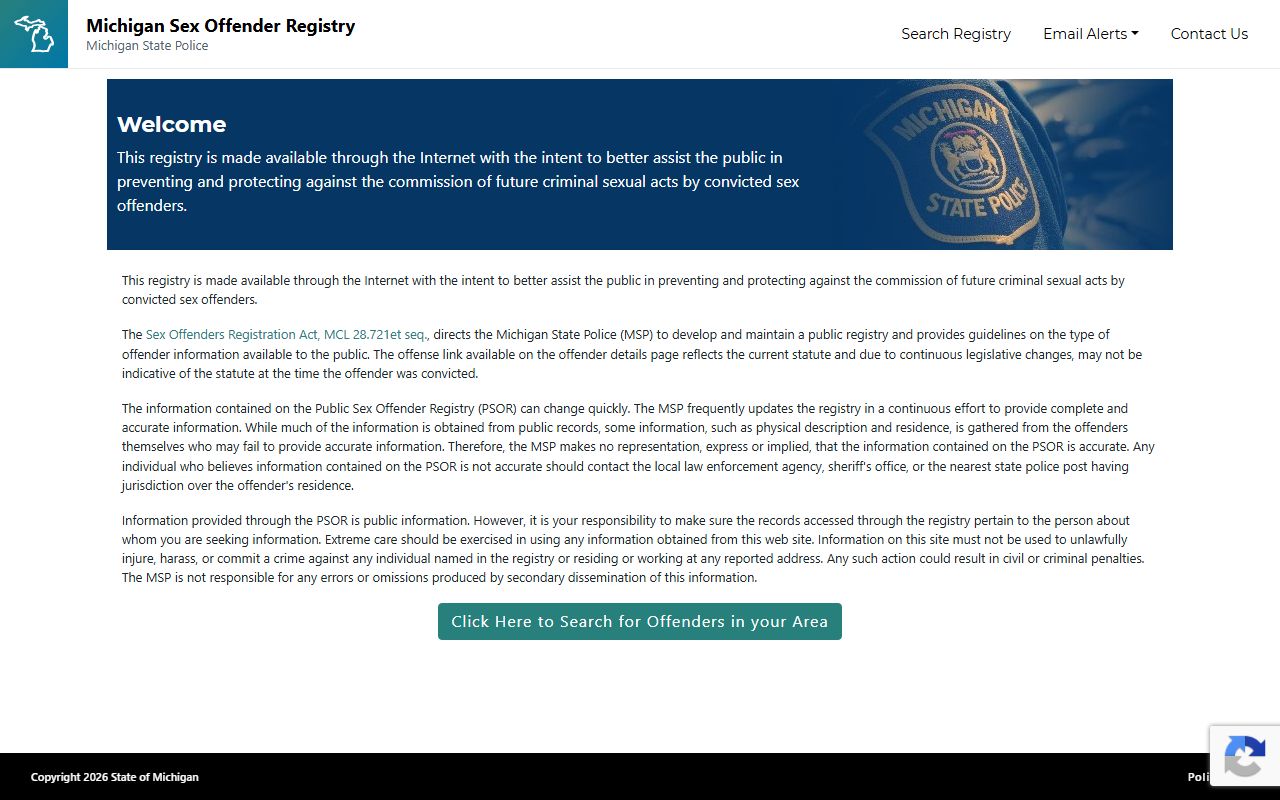
The registry is one of the few statewide databases with a public, name-searchable interface that returns Genesee County data alongside the rest of Michigan.
Juvenile and Restricted Arrest Records
Michigan keeps juvenile records out of public view. Juvenile delinquency files in the 7th Circuit Court's family division are restricted under MCL 712A.28. Parties, attorneys, agencies, and persons with court permission can access these files. The general public cannot. Adoption-related juvenile matters are protected separately under MCL 710.67.
Mental-health probate cases are also restricted under MCL 330.1748. Set-aside cases under MCL 780.621 are removed from public criminal history. PPO files often show a public caption but protect addresses and other safety information. Always check the case status field; a "restricted" flag means the file is closed to general public access even if a docket line is visible.
Bonds, Prosecutor, and Public Defender in Genesee County
For arrestees still in custody, the 67th District Court bond procedure controls. The District Court accepts bonds in person between 8:00 a.m. and 3:00 p.m., Monday through Friday, with cash and most debit and credit cards. Bonds may also be posted at the Genesee County Jail. The automated bond amount line is 810-257-3426. The court links MCL 765.6 for the statutory bond framework.
The Genesee County Prosecutor's Office, led by David Leyton, files charges and prosecutes Genesee County criminal cases. Public Defender questions go to the Genesee County Office of the Public Defender at 810-257-3800 for appointed counsel matters. Specialty courts run by the 7th Circuit Court and the District Court Sobriety Court can divert eligible cases out of standard criminal sentencing into treatment-based supervision.
Background Checks and Genesee County Arrest Records
Background checks pull from multiple sources. A complete Michigan background check generally includes ICHAT for state criminal history, MiCOURT for county-specific Circuit, District, and Probate cases, the Michigan Sex Offender Registry for registrants, OTIS for state corrections data, and a federal source like PACER for federal court cases. Each source covers different ground. None of them is comprehensive on its own.
Genesee County arrest records used for FCRA-regulated decisions like employment, tenancy, or credit must come through a consumer reporting agency that complies with the Fair Credit Reporting Act. Public records published here are not for FCRA purposes. For licensing decisions and government applications, the agency receiving the application usually states which records it requires and whether ICHAT, MiCOURT, or another source is required.