
Genesee County Probate Court Overview
The Genesee County Probate Court handles estates, guardianships, conservatorships, mental-health treatment matters, and related statutory probate filings. The court is part of the Michigan One Court of Justice system and operates from the courthouse complex in downtown Flint. The court's site lists the Probate Records Office, Court Records Requests, Wills for Safekeeping, Trust Registration, Probate Judges, Court Fees, Deceased Estates, Small Estates, Guardianships, Conservatorships / Protective Orders, and Mental Health Treatment.
The image below links to the official Probate Court home page, which is the central navigation point for Genesee County probate procedures.
From that page, users reach the Probate Records Office, the fee schedule, and the topic pages for each Genesee County probate case type.
How to Search Genesee County Probate Records
The Probate Court uses MiCOURT court code P25. The Probate Court navigation links both to micourt.courts.michigan.gov/case-search/court/P25 and to a redirect URL with the same destination. Search by case number when known; otherwise use party name. Probate party roles include decedent, ward, protected individual, fiduciary, petitioner, and respondent, depending on case type.
- Open MiCOURT P25 at the URL above.
- Accept the public-access disclaimer and clear the hCaptcha challenge if shown.
- Choose case number or name search.
- For an estate, search the decedent's last and first name; for a guardianship or conservatorship, search the ward's name.
- Open the case detail to read the Register of Actions, party roles, and event history.
- For certified copies, full pleadings, or restricted matters, contact the Probate Records Office through the Court Records Requests page.
Genesee County Probate Case Types
Probate Court handles several distinct case types. Each follows its own procedural track with different filings, hearings, and oversight obligations.
- Deceased estates - Formal and informal administration of the estate of a person who died.
- Small estates - Petition and order for assignment; affidavit of decedent's successor for limited-value estates.
- Guardianships - For minors, developmentally disabled persons, and legally incapacitated adults.
- Conservatorships / protective orders - For minors and adults whose property needs protection.
- Mental health treatment - Involuntary treatment and related mental-health proceedings.
- Wills for safekeeping - The Probate Records Office accepts wills for deposit during the testator's lifetime.
- Trust registration - Dedicated Probate Records Office function for Michigan trusts.
Probate Definitions
Probate uses specific legal terms. The short definitions below cover the most common terms a Genesee County probate user sees in case filings and orders.
- Testator
- The person who made a will that is now in probate.
- Intestate
- A person who died without a valid will; the estate is distributed under Michigan intestacy law.
- Personal Representative
- Person appointed by Probate Court to administer a deceased estate; also called executor in older language.
- Guardian
- Person responsible for the care or decisions of a minor or incapacitated adult.
- Conservator
- Person appointed to manage another person's property.
- Fiduciary
- General term for anyone with a legal duty over an estate or protected person's interests.
- Letters of Authority
- Court order giving the fiduciary the power to act for the estate or protected person.
Probate Court Contact Information
Two Genesee County offices anchor the probate record process. The Probate Court itself for hearings and filings. The Probate Records Office for record requests and certified copies. Both operate out of the Flint courthouse complex.
Genesee County Probate Court
Courthouse complex
Flint, MI 48502
MiCOURT court code: P25
Probate Records Office
Courthouse complex
Flint, MI 48502
Wills for Safekeeping handled here.
Probate Court Fees
The Genesee County Probate Court publishes a fee schedule for filings, copies, and inventory-based estate fees. The Michigan inventory fee for deceased estates is calculated using a state-published calculator linked from the Probate Court site. Specific dollar amounts should be verified at the Probate Court Fees page before payment because Michigan fee schedules change.
| Service | Source | Notes |
|---|---|---|
| Estate filing fee | Probate Court Fees page | Per case type. |
| Inventory fee | State inventory fee calculator | Based on estate value. |
| Certified copy | Probate Records Office | Confirm fee at the office. |
| Guardianship / conservatorship filing | Probate Court Fees page | Annual reports / accounts also apply. |
| Will safekeeping | Probate Records Office | Deposit of original will. |
| SCAO fee waiver | Court | Available for indigent filers. |
The image below links to the Probate Court fee page.
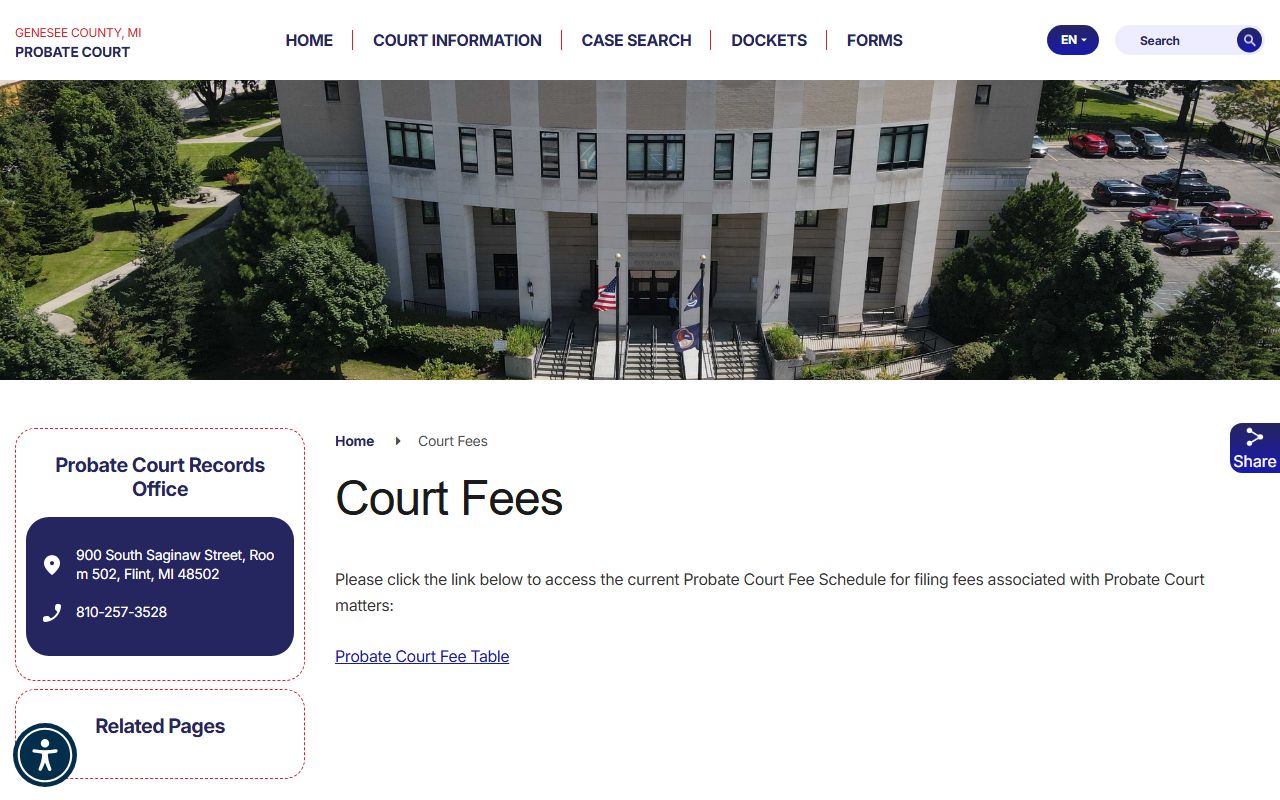
The fee page is the authoritative source for current Michigan probate amounts in Genesee County.
Probate Search Fields (MiCOURT P25)
The Probate search shares the MiCOURT field structure with Circuit and District. The same field set applies, with party roles adjusted for probate matters.
| Field Label | Type | Required | Notes |
|---|---|---|---|
| Court | Preset by URL | Yes | P25 Genesee Probate. |
| Last Name | Text | Conditional | Decedent, ward, protected individual. |
| First Name | Text | Optional | Narrows results. |
| Case Number | Text | Conditional | Court-specific format. |
| Case Category | Dropdown | Optional | Estate, guardianship, conservatorship, mental health. |
Restricted Probate Records
Several Genesee County probate matters are restricted. Mental-health treatment matters are protected under MCL 330.1748. Adoption records are confidential under MCL 710.67. Guardianship and conservatorship files for minors and protected adults often contain medical reports, physician statements, and protected addresses that are redacted or restricted. Sealed probate matters under MCR 8.119(I) require a judge's order before public details disappear.
Estate files generally contain the petition, death certificate, letters of authority, inventory, accountings, notices, proofs of service, orders, and the closing statement. Death certificates inside estate files are usually restricted or redacted, since vital records access is governed separately under Michigan vital records law.
Probate Process at a Glance
The Probate Court process follows a standard path with case-type-specific variations. Below is the high-level flow for most Genesee County probate filings.
- Identify case type: estate, small estate, guardianship, conservatorship, mental health, trust, or will safekeeping.
- Use the Probate Court forms page and the SCAO forms library to pick the right SCAO form set.
- File the petition at the Probate Records Office and pay the filing fee, or request an SCAO fee waiver if eligible.
- Serve interested persons under the applicable Michigan court rule and file proofs of service.
- Attend the hearing if required; some informal estates may proceed administratively without a hearing.
- Obtain letters of authority or the court's order upon appointment or approval.
- File inventories, accountings, and required reports during the case.
- Close the matter by order, final closing statement, or other case-type-specific filing.
Wills for Safekeeping and Trust Registration
The Genesee County Probate Records Office accepts wills for safekeeping during the testator's lifetime. The dedicated Wills for Safekeeping page on the Probate Court site explains the process. A deposited will is held by the Probate Court until the testator's death, at which point the office releases the will to the named personal representative or another appropriate party. Wills held for safekeeping are not public records during the testator's lifetime; they become part of the public probate file only after the estate is opened.
Trust registration is a separate Probate Records Office function. Michigan trust registration is voluntary in most cases but creates a public record of the trust's existence, the trustee, and the situs of administration. Genesee County trusts that are registered with the Probate Court can be confirmed through the Probate Records Office. Trust documents themselves remain private unless filed in connection with a probate proceeding such as a will contest, an accounting dispute, or a guardianship matter.