
Michigan FOIA and Genesee County Public Records
Michigan's Freedom of Information Act took effect April 13, 1977 and gives Michigan residents broad access to records held by Michigan public bodies. MCL 15.232 defines "public body" and "public record" and is the starting point for deciding whether an agency or document falls under the act. MCL 15.233 gives the right to inspect, copy, or receive copies of public records. Genesee County publishes its own FOIA page with current procedures and contact details.
The image below links to the Genesee County FOIA page.
That page is the right starting point for any record request directed at a Genesee County executive agency.
Court Records vs. FOIA in Michigan
Michigan splits public access into two tracks. FOIA covers executive and county-government bodies. Court records are governed by Michigan Court Rule 8.119, the SCAO records management standards, and the court records office of each court. A request to the Genesee County Clerk for a department record uses FOIA. A request to the 7th Circuit Court, 67th District Court, or Probate Court for a case file uses the court records request process. The Michigan Attorney General's FOIA guidance also notes that the judiciary and county clerks acting as circuit clerks are not treated like executive public bodies under FOIA.
That distinction matters because the timing rules, fee structures, and appeal rights are different. FOIA has a written-response timing requirement under MCL 15.235. Court records do not run on the same statutory clock. Both routes give meaningful public access, but the right starting point depends on which body holds the record.
How to File a Genesee County FOIA Request
The county FOIA page sets out the request process. Most FOIA requests can be submitted by email, in writing, or by hand-delivery to the county FOIA coordinator. The request should describe the record sought clearly enough that a public employee can identify it.
- Identify the specific record sought. The clearer the description, the faster the response.
- Submit the request to the county FOIA coordinator using the method published on the county FOIA page.
- Wait for a written response within the statutory time under MCL 15.235; the body may grant, deny, grant in part, or extend.
- Pay the fee or deposit if requested under MCL 15.234; deposits are required for higher estimated fees.
- Receive the records or a written denial citing the FOIA exemption under MCL 15.243.
- Appeal a denial to the head of the public body, or sue as provided in FOIA.
Note: A FOIA request to the Sheriff is processed by the Sheriff's FOIA coordinator; a request to the County Clerk goes to the Clerk's FOIA coordinator, since each public body has its own internal contact.
FOIA Request Form Fields
A Genesee County FOIA request can be filed in a free-form letter or email, but the fields below capture the information that helps the FOIA coordinator process the request quickly.
| Field | Type | Required | Notes |
|---|---|---|---|
| Requester Name | Text | Yes | Full name of the requesting party. |
| Mailing Address | Text | Yes | For statutory written response. |
| Phone / Email | Text | Yes | Contact during processing. |
| Description of Record | Text | Yes | Specific record or class of records sought. |
| Time Period | Date Range | Recommended | Narrow scope reduces fees. |
| Format Requested | Dropdown | Optional | Paper copy, electronic, or inspection. |
| Indigent Fee Waiver | Checkbox | Optional | Eligible requesters may seek waiver. |
| Commercial Purpose Statement | Checkbox | Conditional | Affects FOIA fee calculation. |
Genesee County FOIA Fees
MCL 15.234 sets out the FOIA fee framework. Public bodies may charge for labor, copying, mailing, and other authorized items. Charges must be itemized. Deposits may be required for higher estimated fees. The Genesee County FOIA summary publishes the county's current rules, including request content requirements, response timing, deposit thresholds, fee categories, and appeal rights.
| Fee Category | Statute | Notes |
|---|---|---|
| Labor (search, redaction) | MCL 15.234 | Hourly rate of lowest-paid employee qualified to perform. |
| Copying | MCL 15.234 | Per-page or per-unit charge. |
| Mailing | MCL 15.234 | Actual mailing costs. |
| Deposit | MCL 15.234 | Required for higher estimates per statute. |
| Fee Waiver | MCL 15.234 | Indigent requester or public-interest reduction. |
The image below links to the MCL 15.234 statute page that defines the Michigan FOIA fee framework.
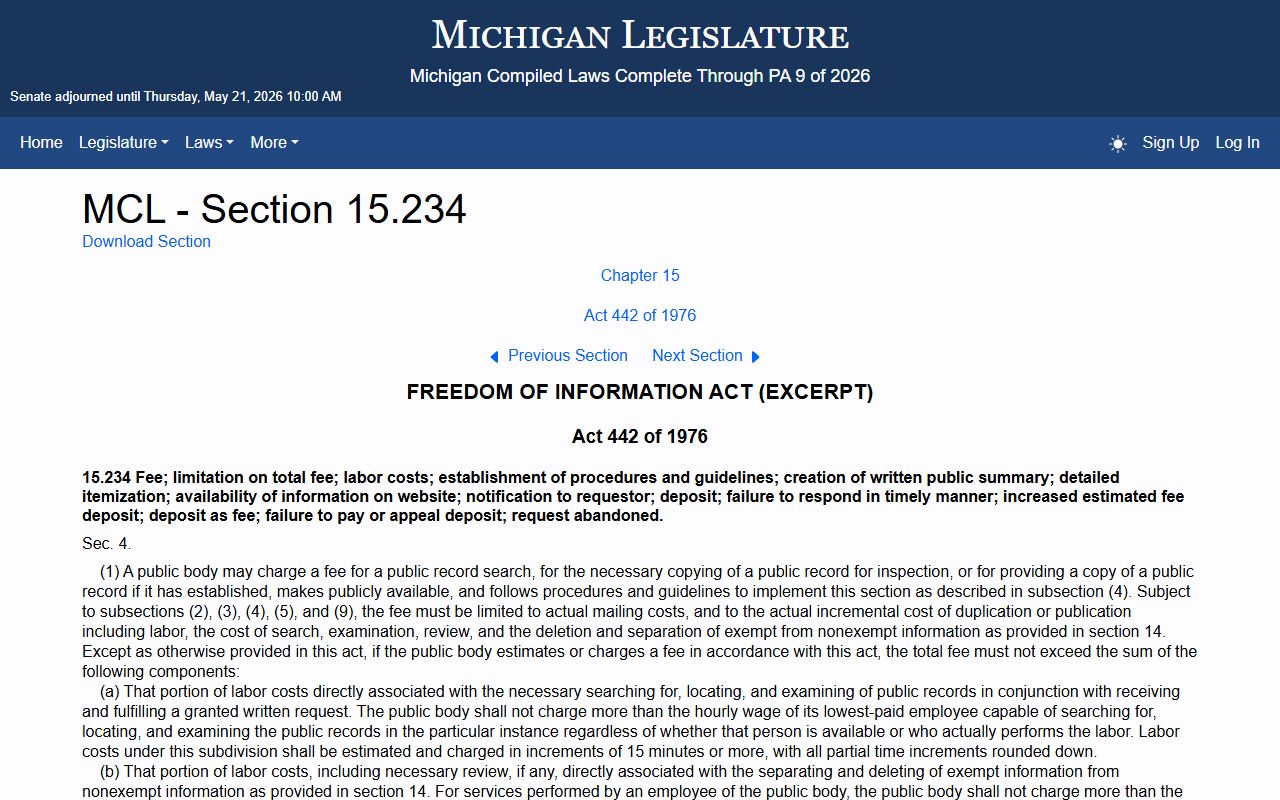
The statute itself is the authoritative reference whenever a fee dispute comes up.
Response Timing Under MCL 15.235
Under MCL 15.235, a Michigan public body must respond in writing within a statutory window after receiving a FOIA request. The response options are grant the request, deny the request, grant in part and deny in part, or extend the response time by written notice. A non-response or late response can give the requester a procedural argument on appeal. The Genesee County FOIA procedures document repeats the statutory timing and adds the county's internal process for routing requests to the right department.
For complex requests that need significant review, a public body may invoke the statutory extension and produce records in stages. The requester can choose to limit scope or accept the extension. A requester who disagrees with the body's invocation can appeal once a final response is issued.
FOIA Exemptions
MCL 15.243 lists FOIA exemptions. Common exemptions include privacy, ongoing law-enforcement investigations, security, privileged material such as attorney-client communications, trade secrets, and records exempted by other statutes. A FOIA denial must cite the specific exemption. A partial grant may release the public portion of a record with the exempt material redacted.
Court records use their own access framework. Juvenile, adoption, and mental-health records are restricted under MCL 712A.28, MCL 710.67, and MCL 330.1748. Sealed cases under MCR 8.119(I) require a judge's order before public access.
What the Genesee County Clerk Maintains Beyond Courts
The County Clerk/Register of Deeds runs three major divisions outside court records. Vital Records manages birth, death, and marriage records that occurred in Genesee County, and also processes marriage license applications, assumed names and DBAs, concealed pistol licenses, and notary applications. Elections administers federal, state, and local elections. Register of Deeds records and indexes deeds, mortgages, liens, and other documents affecting real estate. The Clerk/Register page states that recording a document does not make it legal; it makes it public.
For marriage and divorce records specifically, see marriage and divorce records. For court files, see court records. For clerk-office detail, see County Clerk / Register.
Appealing a Genesee County FOIA Denial
A Genesee County FOIA requester whose request is denied in whole or in part has two main paths. The first is an administrative appeal to the head of the public body. The Michigan FOIA gives the head a statutory window to act on the appeal, with possible outcomes that mirror the original response: grant, deny, grant in part, or extend. The head's decision starts a new statutory clock for further review.
The second path is a lawsuit in Genesee County Circuit Court. A requester who prevails in court may be awarded reasonable attorney fees, costs, and disbursements. The court can also order disclosure of the wrongly withheld records. Punitive damages are available in some cases under Michigan FOIA when the public body acted arbitrarily and capriciously. The appeal and lawsuit paths can run together; the administrative appeal is not always a prerequisite to suit.